

The auction, spanning Monet to Miro, made $190.3m—just above its low estimate—and was preceded by the record-breaking sale of a Ferrari car

The Artistic Freedom Initiative (AFI) urgently called for the safety of Afghan artists who are categorically persecuted by the Taliban as demonstrated in a new report launched today: Artistic Exodus: Afghan Artists Fleeing Taliban Rule. The report, produced in partnership with UC Berkeley Law Pro Bono Program, brings to light the abuse of people working in music, visual arts, performing arts, film and television, literature, museums, cultural heritage sites and arts education since the regime regained control of Afghanistan two years ago.
Artistic expression is now criminalized in the country, with punishments including extrajudicial killings, arrests, arbitrary detention and public humiliation; women and girls have been banned from pursuing arts education and careers; art and cultural sites have been destroyed and removed from public spaces; and arts and cultural institutions, including museums and archives, have been either nearly or completely shut down.

“Kabul did not fall once for us, it fell three times: the first when the Taliban took it, the second when they destroyed our paintings, and the third when they banned girls from going to school,” says Yama Farhad, visual artist and muralist with ArtLords. Farhad has had the laser of a sniper rifle aimed at his head while painting a mural, forcing him to abandon the project for his safety and that of his crew. Other members of the ArtLords group have been wrongfully imprisoned, physically attacked and received death threats.
Many artists in Afghanistan are in hiding, have destroyed, hidden or left behind their artworks and tools, live in dire economic situations due to being unable to practise their craft and earn a living, and are in constant fear of Taliban persecution. Despite the circumstances, international immigration and resettlement assistance has been extremely limited.

“The horrific conditions that Afghan artists face in their home country and the overt targeting of these groups by the Taliban should logically infer a well-founded fear of persecution for Afghan artists openly practising their craft,” says Sanjay Sethi, AFI Co-Executive Director. “That’s why we’re calling for the prima facie recognition of Afghan artists as refugees, meaning that they are automatically considered a refugee and therefore entitled to lawful, permanent residency in a safe host country, unless there is evidence to the contrary.”


2021 Kabul airlift | Courtesy of Fatimah Hossaini
Thus far, states have not prioritised Afghan artists for resettlement, with the exception of Germany, which has created a special pathway for artists and creative workers to seek humanitarian admission into the country. Germany approved humanitarian visa applications for more than 37,000 Afghans from August 2021 to October 2022, and it continues to offer a pathway for artists to enter the country though the Bundesaufnahmeprogramm. On the other hand, the United States – partly responsible for the destabilisation of Afghanistan after their precipitous withdrawal from the country in August 2021 – has not offered similar assistance and has even denied entry to Afghan artists with approved visa petitions.
AFI has provided legal and resettlement assistance to more than 1,100 Afghan artists and their family members since the beginning of the Taliban takeover and has communicated with hundreds of others in distress as they struggle for personal and professional survival. The new report tells the stories of some of these visual artists, musicians, filmmakers, archeologists and curators to highlight the real life impacts of the political crisis in Afghanistan and subsequent forced migration.

“Leaving the country is a painful feeling, but [figuring out] how to leave was a big challenge for me and I was alone,” says Shaista Langari, visual artist and women’s rights activist, who faced additional dangers both living in Afghanistan and while fleeing as a female artist.

Given the hostile environment for creatives at home and the lack of institutional support for the artists abroad, the rich artistic tradition of Afghanistan that stretches back millennia and is fundamental to Afghan cultural identity is facing obliteration. Afghan artists who have relocated to other countries need help in resettlement, such as access to basic services including housing and healthcare, as well as support to rebuild their creative careers in their host communities. The provision of such services can help to ensure that host countries fulfil their international legal obligation to protect Afghans’ cultural rights and safeguard the intangible cultural heritage of the Afghan people.
“Art is also a powerful tool in creating social and political change and one of the last hopes for resisting violence and oppression in Afghanistan, whether through artists in the country or those abroad and feeding back into it,” says Omaid Sharifi, Artlords Co-founder/President.


AFI calls on the international community to maintain pressure on the Taliban to implement critical recommendations by UN special procedures and bodies and to press governments to provide immigration relief and implement best practices aimed at supporting artists at risk. We call on all state and non-state actors to offer additional support to Afghan artists seeking asylum and for legal aid organizations to increase assistance for Afghans to determine their eligibility and apply for refugee status, humanitarian parole, and temporary or long term visas.
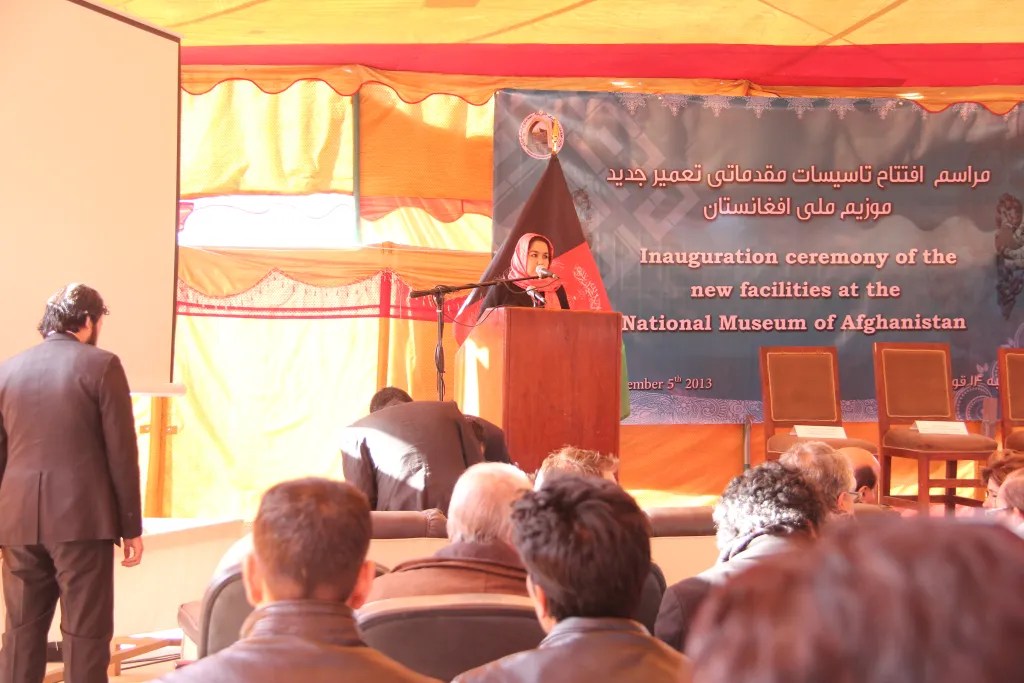


Nasrin Belali speaks with a reporter about her archeological work at the National Museum of Afghanistan | Courtesy of Nasrin Belali
The report also highlights how arts and cultural institutions, universities, and arts-oriented non-profits can assist in Afghan artist relocation and resettlement through sponsored fellowships and work opportunities. Finally, we highlight the need for increased humanitarian aid and other forms of support for the thousands of artists still in Afghanistan that continue to face persecution from the Taliban.



Artistic Freedom Initiative (AFI) is dedicated to safeguarding the right to artistic freedom and facilitates pro bono immigration representation and resettlement assistance for international artists at risk. Led by immigration and human rights attorneys, the organization anchors its work to the shared commitment of protecting and celebrating cultural diversity, human dignity and freedom of artistic expression. Beyond AFI’s work to provide holistic relocation and resettlement opportunities for artists under threat, it is also focused on the advancement of creative cultural exchange and the improvement of conditions for artists in their home countries.


Also Read
Dutch Artist Willem Vos to Exhibit in China with a Message “Art is Freedom”

Story submitted by Artistic Freedom Initiative. The World Art News (WAN) is not liable for the content of this publication. All statements and views expressed herein are opinions only. Act at your own risk. No part of this publication may be reproduced without written permission. © The World Art News

The Helen and David Milling Collection, featuring the finest British and American art pottery and glass from the late 19th and early 20th centuries, will be showcased at Bonhams this December. Over the span of half a century, the Michigan couple meticulously assembled an exceptional collection from some of the era’s most renowned potters, designers, and artists. This distinguished assortment comprises more than 350 lots, to be presented across three sales this December: 20th Century Decorative Arts and Ceramics on December 5 in London, Modern Decorative Art & Design on December 12 in New York, and the dedicated Helen and David Milling Online auction from December 8–18 at Bonhams Skinner.
Helen and David, both with backgrounds in the arts and architecture, cultivated a fascination for Arts and Crafts ceramics, Art Nouveau tiles, and American iridescent shades from an early age. Following their marriage, their passion for collecting deepened. United by their love for the Art Nouveau movement and inspired by Robert Schmutzler’s book, “Art Nouveau” (1964), they were drawn to vibrant colors and fantastical designs.

Their focus extended to English Art Nouveau tiles and American iridescent lamp shades crafted by Tiffany Studios, Quezal, and Steuben. Over time, their collection expanded to encompass Arts & Crafts designs, including ceramics by notable makers such as William De Morgan (1839-1917), Walter Crane (1845-1915), and Sir Edward Coley Burne-Jones (1833-1898) for William Morris (1834-1896). The resulting collection pays homage to the Victorian era and reflects a lifelong commitment to acquiring high-quality works.

The December 5 sale in London will feature 79 works from the collection, including the noteworthy ‘Hearing,’ an Important ‘Senses’ ceramic figural panel designed by Walter Crane (British, 1845-1915) for Pilkington’s, circa 1900. Estimated at £8,000 – 12,000, this rare panel depicts a classical maiden cupping one ear with her hand and holding a lyre in the other. Also featured is the ‘Alfred Ye Greate’ panel, after Ford Maddox Brown, 1900 by Harold Steward Rathbone (British 1858-1929) for Della Robbia Pottery, estimated at £3,000 – 5,000. This molded ceramic panel in two sections depicts the Saxon King Alfred and is painted in colors and glazed.

The Modern Decorative Art & Design sale on December 12 in New York will include 52 works, with a highlight being a mosaic panel designed by Louis C. Tiffany, circa 1890, estimated at $30,000 – 50,000. Rare examples of Tiffany Studios’ mosaic panels commissioned for specific interiors and architectural projects are highly sought after. Another notable piece is William De Morgan’s (1839-1917) Three-tile Frieze, circa 1890-1900, estimated at $15,000 – 25,000, featuring fantasy birds in the triple-lustre-glaze technique introduced at the Fulham factory.

The online sale at Bonhams Skinner from December 8 – 18 will offer over 200 lots from the collection, showcasing a diverse range of ceramics and tiles primarily from Victorian England, extending to American Arts and Crafts. The collection encompasses works from renowned design firms of the period, including Royal Doulton, Martin Brothers, Maw & Co., Pilkington, and Wedgwood, reflecting Helen and David Milling’s broad interest in design movements such as Gothic Revival, Aesthetic Movement, Arts and Crafts, and Art Nouveau.
Bonhams, founded in 1793, is one of the world’s largest and most renowned auctioneers, offering fine art and collectables, collectors’ cars and a luxury division, which includes jewellery, designer fashion, watches, wine, and whisky. In 2021 and 2022, Bonhams made a number of important acquisitions which form the wider Bonhams network. These include: Bukowskis, Bruun Rasmussen, Bonhams Skinner and Bonhams Cornette de Saint Cyr.
Top lots for 2022 included a 1955 Porsche 550 Spyder (Sold for US$4,185,000), a pair of blue and white octagonal candlesticks (Sold for HK$30,453,00/ US$3,911,913), La femme en rouge au fond bleu by Chaïm Soutine (Sold for £1,842,300/ US$2,236,940), and a rare emerald and diamond Cartier bracelet (Sold for US$3,240,375).
Story submitted by Bonhams. The World Art News (WAN) is not liable for the content of this publication. All statements and views expressed herein are opinions only. Act at your own risk. No part of this publication may be reproduced without written permission. © The World Art News
The theft from Carlton Fine Arts on Madison Avenue has led the gallery’s owner to beef up his security systems, at great expense
In his new documentary “Angel Applicant”, Ken August Meyer finds solace in the late works of Klee, who likewise suffered from scleroderma
Jorge Pérez, who gave the museum $35m in 2013, is renewing his support
Frederick Iseman is suing the foundation of which he was until recently board president, accusing it of practicing “grabstract expressionism”
The billionaire Jindal family will open the exhibition venue and artist residency space in February next year
Formerly the Miller ICA, Carnegie Mellon University’s contemporary art gallery will more than double its space when new facility opens in 2027

BY VENIZELOS G. GAVRILAKIS | Senior Expert Artworks Conservator & Restorer
In the realm of art, where creativity intertwines with history, the expertise of art conservators and restorers holds unparalleled significance. Art Conservation and Restoration emerge not just as processes of preservation but as transformative journeys that breathe new life into artworks. This article explores the profound impact of art Conservation and Restoration on the value of artworks, unraveling the meticulous efforts that enhance their cultural, aesthetic, and market worth.
The resounding success of the restoration of “Salvator Mundi,” a masterpiece attributed to Leonardo da Vinci, stands as a testament to the transformative power of art conservation. After meticulous restoration efforts, this iconic artwork, lost for centuries, was unveiled to the public, showcasing its original brilliance. In 2017, “Salvator Mundi” was sold at auction for a record-breaking $450.3 million, highlighting the immense financial value that expert restoration can bring to a work of art.

Other instances in the art world vividly underscore the profound financial impact of restoration, showcasing the market’s fervent appreciation for the meticulous revitalization of cultural treasures. Notable among these success stories are masterpieces by renowned artists, each bearing a rich history of restoration and commanding significant prices at auctions.
One striking example is Rembrandt’s masterpiece, “The Night Watch.” After a meticulous restoration process aimed at reviving the depth and vibrancy of Rembrandt’s original vision, the painting was unveiled in all its glory. In 2019, this restored masterpiece fetched a staggering $164.2 million at auction, a testament to the immense value placed on preserving and enhancing the visual splendor of iconic works of art.

Similarly, the restoration journey of Van Gogh’s “Starry Night” captured the imagination of art enthusiasts worldwide. The delicate process of cleaning and conserving this celestial masterpiece revealed previously obscured details and brought forth the brilliance of Van Gogh’s swirling night sky. Following its restoration, “Starry Night” was sold at auction for an impressive $93.5 million, symbolizing not only the astronomical appreciation for Van Gogh’s genius but also the market’s recognition of the transformative impact of expert restoration.
Picasso’s iconic “Les Demoiselles d’Avignon” also underwent a meticulous restoration process to revive the vivid colors and intricate details of this groundbreaking Cubist work. Post-restoration, the painting achieved a remarkable price of $132 million at auction, solidifying its status as a testament to both Picasso’s artistic innovation and the significant financial returns that can result from careful restoration efforts.

These instances illuminate the symbiotic relationship between restoration and market value, with collectors and investors recognizing the enhanced allure and cultural significance that meticulous conservation efforts can bring to iconic artworks. As these restored masterpieces continue to captivate audiences and command substantial prices, they stand as compelling examples of how the marriage of artistic preservation and financial value can elevate the cultural and economic standing of these invaluable treasures.
Artworks are timeless storytellers, echoing the cultural heritage of nations and history. Conservation and Restoration safeguard this legacy by ensuring artworks survive the passage of time. Beyond mere preservation, these processes rejuvenate artworks, infusing them with renewed vigor. In preserving the essence of cultural narratives, artworks become not just relics but vibrant symbols of the global cultural heritage, amplifying their historical value.

The science and art of Conservation and Restoration lie in their ability to reveal hidden splendors. Skilled senior conservators meticulously revive colors, textures, and forms, restoring artworks to their authentic original magnificence. This revitalization doesn’t merely revive appearances; it rekindles emotions and captures imaginations. Artworks, once dulled by age, regain their brilliance, captivating viewers and enhancing their intrinsic allure and market desirability.
Authenticity is paramount in the intricate world of art. Conservation and Restoration processes involve intensive research, shedding light on an artwork’s origins and history. This meticulous scrutiny validates provenance, ensuring artworks are genuine treasures. Certainties about an artwork’s authenticity instill confidence among collectors and investors, amplifying its value as a testament to artistic ingenuity and historical importance.

The art market is a realm where passion converges with investment acumen. Well-preserved and professionally restored artworks meet the discerning demands of collectors and investors. Artworks that have undergone expert museum-level conservation and restoration become prized acquisitions, reflecting both aesthetic sophistication and sound investment choices. Their documented history and rejuvenated state cater to the preferences of astute buyers, propelling their market worth.
Through the careful hands of art conservators and restorers, artworks transcend time, resonating with authenticity, beauty, and historical significance. Preservation efforts don’t merely conserve; they amplify the worth of artworks, making them not just financial assets but enduring testaments to human creativity. In the delicate dance between past and present, the value of art is not just preserved; it’s magnified, ensuring that each brushstroke and intricate detail continue to inspire and captivate generations to come.

Venizelos G. Gavrilakis is a highly esteemed senior expert in the conservation and restoration of Byzantine and post-Byzantine icons, historical oil paintings, artworks, and antiquities, renowned worldwide for his exceptional expertise. With a strong academic background, Venizelos graduated from a Ministry-certified conservation and restoration faculty in Greece, specializing in the preservation of artwork and antiquities. He further honed his skills through dedicated studies in paintings restoration and conservation at the prestigious Conservation Fine Art Faculty of Palazzo Spinelli in Florence, Italy. Since 1994, Venizelos has served as a senior expert conservator and restorer, undertaking numerous noteworthy projects across the globe. His remarkable career includes managing director positions at conservation laboratories in renowned institutions, collaborations with galleries and private collectors, and contributions to conservation journals. Mr. Gavrilakis is a member of KMKD Kültürel Mirası Koruma Derneği (Association for the Protection of Cultural Heritage). Currently, he is at the helm of VENIS STUDIOS, a leading conservation and restoration company headquartered in Istanbul, Turkey. The studio is dedicated to delivering exceptional services worldwide, ensuring the preservation and restoration of historical artworks and monuments at the highest level of craftsmanship.

Also Read
Salvator Mundi: a Bone of Contention – Prominent Art Restorer Speaks Out

The World Art News (WAN) is not liable for the content of this publication. All statements and views expressed herein are opinions only. Act at your own risk. No part of this publication may be reproduced without written permission. © The World Art News